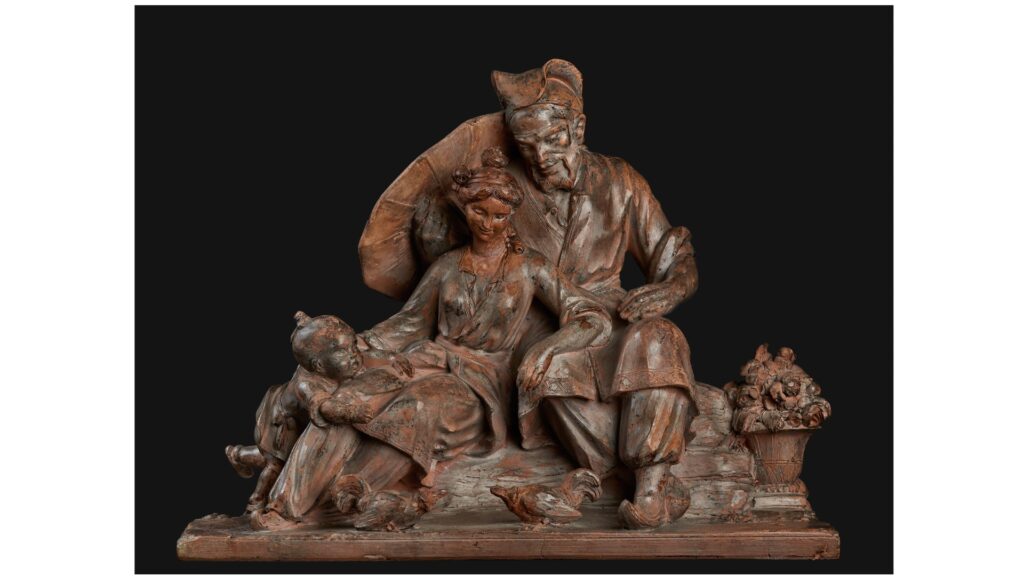
Josse François Leriche was born in Mons, Belgium, in the province of Hainaut, in 1738. After training with Etienne Falconet (1716-1791), he joined the Sèvres porcelain factory in 1757 as a sculptor and held this position until 1768. He then became a modeler, and in 1780, he took the position of head sculptor for the rest of his career (until 1801). Forty-three years of service at the Royal Porcelain Factory allowed him to develop his skill in modeling. This beautiful terracotta group with a silver patina is a very good example of this.
It depicts a Chinese man, his wife, and their child clinging to his mother’s dress. At their feet, chickens peck at the grains. Should we see this as an allegory of the fruits of a marriage, producing grain that feeds the household? This is not certain. At the Sèvres factory, Leriche developed a series of figures and scenes related to the theater, a very popular pastime in the last quarter of the 18th century. He did not fail to depict great actors such as Préville, in the role of Figaro.
Our group is rather inspired by the vogue for china that prevailed throughout the 18th century, particularly from the 1730s onwards, in the wake of Christophe Huet’s (1700-1759) decorations for the Château de Chantilly (1737), with the spread of models engraved by François Boucher (1703-1770), Gabriel Huquier (1695-1772), and the series engraved by Jean-Baptiste Pillement (1728-1808).
The terracotta group we are presenting is similar to another similar group sold at Christie’s on November 15, 1984 (lot 318). It was signed and dated: “j. Leriche fec. 1785”, which could allow us to date our work around that date. The subject could be inspired by the cartoons for the Chinese hanging designed by François Boucher to be executed as a tapestry at the Beauvais factory.