Pietro della Vecchia is one of the major figures of seventeenth-century Venetian painting, whose abundant work covers all subjects, including religion, history, gender, and even figures. His first dated work dates back to 1620 and demonstrates the influence of Carlo Saraceni and Jean Leclerc, who brought to Venice a chiaroscuro inherited from their years in the Caravaggesque movement in Rome.
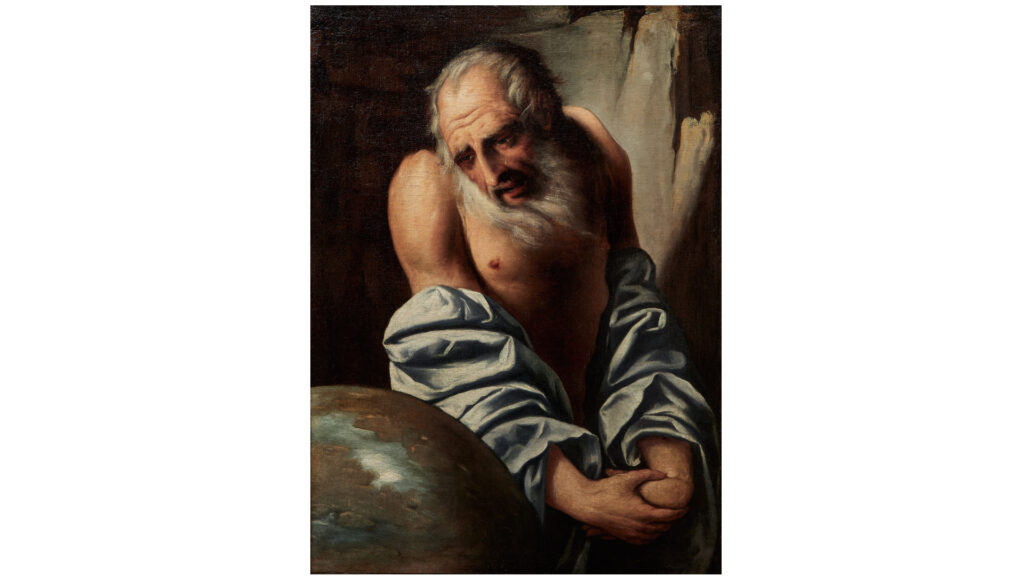
Around 1625, he joined the studio of Padovanino (1588-1648), a continuator of the Renaissance tradition, and primarily of the style of Titian; this influence would have a lasting impact on him, leading to the production of fake Giorgione or Titian paintings, which he traded in partnership with his father-in-law, the painter Nicolas Régnier (1591-1667). Under the influence of the Genoese Bernardo Strozzi (1581-1644), who had settled in Venice, he brightened his palette with vibrant colors. From 1640 to 1674, he produced the models for the mosaics for St. Mark’s Basilica, and then created various large religious cycles for Venice, Treviso, and other churches in the Veneto region. The ancient philosopher, pessimistic and melancholic, Heraclitus is frequently paired with Democritus, aptly represented by della Vecchia in a painting very similar in size to ours (96.5 x 73 cm, private collection in Paris, no. 123 of the artist’s catalogue raisonné published by Bernard Aikema; Pietro della Vecchia and the Heritage of the Renaissance in Venice, Florence, 1990), to the point that one is tempted to see it as a counterpart to our painting.